Showing posts with label Rhodent Rants. Show all posts

Saturday, September 22, 2007

On The Rant Again...


After the recent anniversary of 9/11, and news items such as football players involved in running dog fighting matches , the unending reports of vicious killings in the Middle East and Africa, and the continuous reports of senseless violence against people and animals in our own country, I thought the following quotes would be appropriate to post:


"Anyone who has accustomed himself to regard the life of any living creature as worthless is in danger of arriving also at the idea of worthless human lives." - Albert Schweitzer


"We cannot have peace among men whose hearts find delight in killing any living creature." - Rachel Carson, American Author and Marine Biologist


"Of all the creatures, man is the most detestable. Of the entire brood, he's the one that possesses malice. He is the only creature that inflicts pain for sport, knowing it to be pain. The fact that man knows right from wrong proves his intellectual superiority to the other creatures; but the fact that he can do wrong proves his moral inferiority to any creature that cannot." - Mark Twain, American Novelist


Over the past few years we have had local news reports of teenagers breaking into pens and purposely torturing pigs and horses, shooting pet cats with arrows, and beating dogs nearly to death. I shudder to think what these "kids" will be like when they are adults.

There are times when killing someone or something is necessary, but I can't imagine ever being delighted over doing so. I can't begin to understand the mind of a terrorist. I will never understand how any sane person can take pleasure in murder or torture.

Tuesday, November 28, 2006

Ranting Again...


It has taken me longer than I had anticipated to get to composing this rant, so some of the steam may have escaped. However, I think that the main points are still intact. Here goes...

Illegal immigration woes are an often debated subject these days. Especially the problem with illegal immigrants from Mexico. I don't disagree that illegal immigration from Mexico is creating many problems here in the USA, and places many burdens on communities that try to provide health care, education, and other services for the illegal Mexicans. On the other side of the coin, these illegal immigrants are providing cheap labor force for industries that need it. Those arguments are not what I am ranting about.

I had the opportunity to chat with a very well educated, legal Mexican immigrant who has previously worked in our area as part of a faith-based organization called FAST (Faith and Action in Service Together). This group organized people to lobby local politicians to provide for community needs such as safer school bus stops. He left our area to work for a national immigration committee. My conversation with this man opened my eyes to a source of some of our illegal immigration problems.

It seems that at one time small individual or family businesses employed 90% of the work force in Mexico. Mexico has a minimum wage that was typically significantly lower than what the majority of the workers earned in these small businesses. Enter the American corporations... Small towns across our country have experienced a bit of what has happened in Mexico. WalMart, Home Depot, or similar types of superstores move into town and with lower prices, drive the smaller stores out of business. In Mexico these corporate gars generally do not pay much above the Mexican minimum wage.

Once again we see the results of corporate greed and arrogance. Fewer jobs, lower wages, and the lure of better things across the border tempt many Mexicans to risk their lives in an attempt to find work in the USA. If they make it (and many don't), they are able to send money home to Mexico to provide for family members left behind. The unlucky ones die crossing or get stuck in sweatshops or other underground jobs that treat them as slaves.

When we complain about these illegal immigrants, I think we need to consider the fact that it is some of our own corporations that are exacerbating the problems. They get to pay lower wages and make higher profits at the expense of both Mexican and American workers. Perhaps before our country spends exorbitant amounts of money on building a wall along the border, we could somehow address what could be done to reverse what our corporations have done in Mexico. If the number of illegal immigrants declines, we will be better able to deal with the smaller numbers and concentrate on those crossing that provide a security risk or are intent mainly on criminal activity.


Sunday, August 13, 2006

Containing Terror


I was relieved the other day to hear that another terrorist plot had been discovered and stopped. Somehow though, that does not help me feel safe. It just seems to refocus my mind towards contemplating the potential for further trouble. There are probably many more plots being brewed around the world.


While I am grateful for the elimination of the captured terrorists, I am reminded of how much of the world seems bent on destruction of what they perceive the USA to be. Representatives of our country doing business and traveling overseas do not always shed the most flattering of lights on the rest of us. I cringe at the thought of what so many people around the world think of us. Some of the terrorists don't need the excuse, some see our greedy image as justification for their handiwork, and some become terrorists because of unfortunate business and government policies.

Don't get me wrong. I love this country. What I don't love is the waste and greed that seems to overshadow the good intentions of many Americans... including many of those serving overseas. But the facts still remain that there should be enough food produced around the world to prevent the widespread hunger that exists, that the US uses far more resources than most of the world, and that we have failed to produce and use new technology to reduce our dependence on resources that pay for the perpetuation of governments that suppress their own people.

The greed and corruption in foreign governments is something that we have little control over. We have failed to eliminate it in our own government. However, what exists in the US is minor compared to what exists in some countries around the world. We donate money to organizations to help fight starvation and to aid in disasters, but too often the money gets funneled into other uses. Some of the things we can do are to elect those officials who promote sound policies locally, nationally, and internationally, to support those elected officials as well as keep them accountable, and to educate ourselves about current conditions in our country and around the world.

Maybe through wiser national and international policies, if we are gradually able to eliminate the conditions that are the seeds of terrorism, it will cease to be the problem that it has become. So, when you have the chance, support education-- not only do we need to improve it here in the US, but we need to support the programs that provide for education around the world. Continue to support responsible agencies that provide aid around the world. Support US companies that have good track records overseas. Vote wisely. Do what you can. Just don't put your head in the sand while proclaiming that we are the best. We need to stop proclaiming our former glories while failing to see the needs that now exist in our own country.

We have the ability to be the best, but we are failing in too many areas. Americans have always been able to meet their challenges. How much longer will we be able to do so if we do not take a realistic look at the problems that exist in our own country and around the world, and if we continue to become more and more dependent on our federal government to take care of our every need. What has happened to the American spirit that took pride in being self-sufficient? Have we given up the dream that our country allows those who put forth the effort to excel and do great things?

I believe we still hold onto that fierce compassion for others as evidenced by our aid in disasters around the world. What we lack is a perception of our world as it really is today. We are failing to see those festering disasters that exist and don't necessarily make the daily headlines. And we are failing to educate ourselves and our children to become world-wise.

Okay, I'm done now. It has been a while since I have done a "Rhodent Rant" and I think I have rambled on enough for now. I just needed to get it out of my system tonight!

Saturday, November 19, 2005

Not Quite A Rhodent Rant


This is not quite a rant. I am not angry, just rather annoyed... perhaps a bit perplexed. The newer versions of the drug commercials on TV have really been getting on my nerves.

It used to be that they would advertise some new drug and claim that it cures everything but housemaid's knee. If you want to cure housemaid's knee, you will need to try their non-drowsy formula with the stomach-protecting coating. Then there was the routine of "don't forget to ask your doctor about..." where the purpose of the drug is not revealed. The viewer is left wondering what on earth the drug is supposed to fix because they never say for what purpose it is to be prescribed! Sure, you are going to go to your doctor and tell him/her that you need this drug even though you have no idea what it does! I guess you are supposed to go to your doctor and ask him what it does. He probably doesn't know yet either! More recently a drug would be mentioned with all of the usual claims, and then at the end of the commercial some man would report the negative side effects at a speed so fast that no one could understand him... well maybe an auctioneer could figure some of it out.

Now we have the newest form of the drug commercials... The drug is introduced to the viewer by a pleasing voice with wonderful scenery and very good looking people. Then at the end of the commercial a very friendly female voice recites the entire list of bad side effects in such a way that if you are only half listening, you would think that these were good things to experience... Like, isn't it wonderful that you could experience shortness of breath, rapid heartbeat, dizziness, heart attack, or even (if you are lucky) death! And if you are listening closely, you have to ask yourself why these are considered good things, because clearly, the female voice seems to indicate they are desirable! What idiocy!

Ok. I'm done.

Monday, September 05, 2005

Another Rhodent Rant

"Hmph!" yet again!


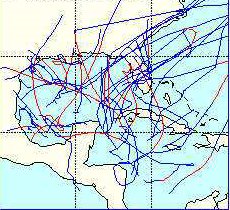
I have been putting off this post because of the amount that I have to say. Everytime I sit down to start this rant I realize how much is involved. It is difficult to know where or how to start, and I wonder if anyone will take the time to read this whole post. I will try to break up the text with some appropriate illustrations for my points. The subject is, not unexpectedly, the problems before, during and after Hurricane Katrina.

The storm and the problems associated with it are larger
than any experienced in this country ever before.


There are no easy answers here, but some common sense is definitely in order. Disaster and hurricane preparedness is not an exact science. All anyone can do is draw upon prior experience, scientific projection, common sense, and the basic desire of most Americans to do the right thing. I have attended numerous hurricane conferences here in Florida over the years. They are large conferences and well attended by emergency management, medical people, Red Cross and the numerous other volunteer organizations that activate during a disaster. From what I have learned at those conferences, I have some pertinent things to say about what has happened and the efforts involved in the relief efforts.

Let's address prior experience first. At every Florida Governor's Hurricane Conference that I have attended in the past, a common theme has always been "lessons learned" from the previous season's storms. The first one I attended was the season after Hurricane Hugo. In the years following, some of the storms addressed were the infamous "March No-Name Storm", Hurricane Andrew, Hurricane Opal, Hurricane Georges, and the numerous other storms that have impacted our area of the world. I learned a lot and so did the relief agencies with each year's disasters. Even before Andrew hit Florida (and then LA) in 92, emergency managers talked about what potential for disaster awaited in the most vulnerable parts of our country. These have been and still are Monroe County, FL (aka the Florida Keys), the Long Island area of the Northeast, the Tampa Bay area of Florida, and or course, the bowl of New Orleans.

Anywhere a category 4 or 5 Hurricane hits is vulnerable. Devastation is to be expected. Last year when the Tampa Bay area was bracing for Hurricane Charley, many people evacuated to Orlando and other areas in the middle of the state. Then Charley took a strong right turn, hit Port Charlotte and Punta Gorda, and many of the evacuees from the Tampa Bay found themselves in worse conditions as Charley crossed the state than were experienced in the Tampa Bay area. My point: as prior experience tells us, these storms are still unpredictable. A slight change in direction, forward speed, or a mere few miles difference in the area of landfall can make a huge difference.

So back to New Orleans (remembering that this was NOT the only place hit!)... For years it has been known what a vulnerable city New Orleans would be if hit by a major hurricane. Were the major preparations for this eventual disaster entirely the responsibility of our federal government? To answer this question, I think I will use my own Pinellas County of the Tampa Bay area as an illustration...


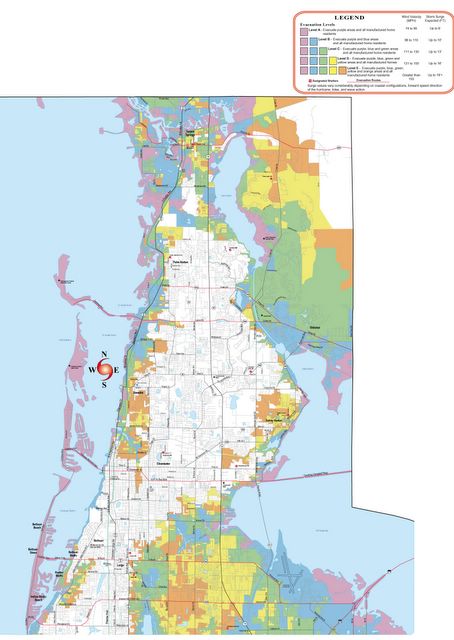
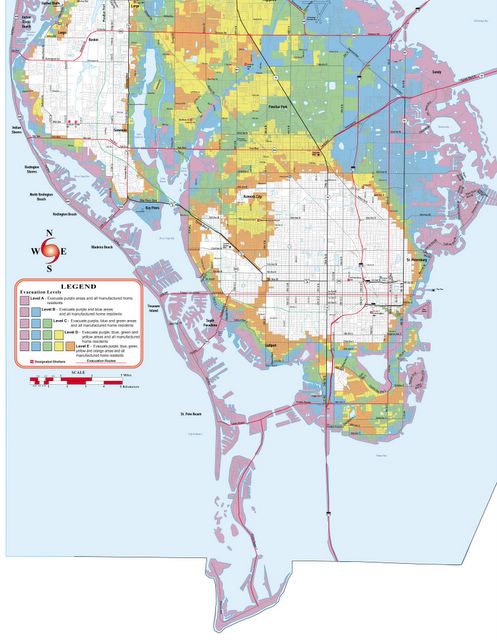
These maps are the evacuation maps of upper and lower Pinellas County. Pinellas County is a peninsula on a peninsula. Lower Pinellas County is the home of the larger city of St. Petersburg. Notice how the center of the city becomes an island from the storm surge of a major hurricane. Upper Pinellas also becomes detached from the mainland. I also would not expect the three bridges from Pinellas to Tampa to hold up in a major storm. So what we have left are two islands on the West Coast of Florida... at least until the storm waters recede, the roads are fixed, and the bridges repaired... repaired after the storm has passed the area and those responsible for the repairs can get their equipment in place. It is expected that in a category 5 hurricane the downtown area of Tampa would be hit by a storm surge of 26 feet or higher. That's a lot of water and a lot of damage and more debris and roads to be cleared before Pinellas County can receive aid by any means other that boat or plane.

In the meantime... no water, no services (electrical, sewer, garbage, telephone, cell phones). Telephone lines have to be reconnected. Power lines and transformers have to be repaired, cell phone towers have to be repaired and put back into place, roads have to be cleared of debris... etc, etc, etc. One of the biggest points made at the hurricane conferences were that communications is always a major issue initially and that the people impacted by the storm are not in a good position to evaluate their own needs and the damage that has been done. That is where the state level emergency management agencies come into play... and FEMA comes in as soon as the state governor requests aid and the area is named a disaster area.


But what are the responsibilities of the people in the impacted area? Individuals that have the means to do so should prepare their homes for the storms. This means to have proper window protection, a "safe room" ready, the appropriate foodstuffs, water, and first aid supplies necessary. Everyone in the impacted area needs to be able to be self-sufficient for at least three days and probably should be prepared for at least a week. If you are in an evacuation area in Pinellas County, you need to get out EARLY! I could go on about these types of issues, but this information is available in many places.

People who live on the barrier islands, no matter how many times they are warned often do not choose to evacuate. Once the bridges are closed, they are on their own. After the storm they will require extra time and effort to rescue. Whose fault is that?

So what about the people that do not have the means to prepare their homes? Do they have the ability to evacuate to safety and sustain themselves for what could possibly be weeks? There is a shortage of hurricane shelter spaces in Pinellas County. There are many elderly who have special needs, such as Oxygen, that need to be in a place where their needs can be met. There are many people whose only mode of transportation is a city bus. This is where I think that the local governments and emergency management have the responsibility to provide transportation and shelter.


Some people will always bury their heads and ignore their peril until the last minute.

However, every year, at the last moment when a hurricane is threatening, people with special needs who have not bothered to register with the fire department or other government agencies responsible for getting them to a special needs shelter, are calling asking for help. This is hard to do at the last minute. It also makes it hard to have adequate supplies in place to meet the needs of the numbers who arrive... even when they plan for extra people. But still, I believe that it is the responsibility of the local governments and emergency management offices to have in place plans to evacuate people who have no transportation and who are in need of extra help. That is the type of things that can be planned for ahead of time utilizing city busses, school busses, and various types of emergency equipment where appropriate. It is NOT, however, the responsibility of the federal government.

Another problem that I see is greed. Local governments allowing homes to be built in areas along the bay that are only 3 to 4 feet above sea level and in areas that were once filled with mangroves, nesting sites for birds, and by no means safe from even a small storm surge. Now, their stupidity makes them the responsibility of federal flood insurance programs. Duh. Local governments greed for a larger tax base and compromising their cities to big developers for whatever reason causes a greater load on emergency management and relief agencies. Personally, I don't like the federal government providing flood insurance for $500,000.00 homes on the water. The money could be better spent elsewhere. Like providing grants to communities that ARE interested in disaster mitigation.

Knowing that a problem exists does not necessarily mean that it is easily fixed. If it involves relocating homes, local politics, people's egos, and greed, it becomes almost impossible to fix. Should downtown Tampa be relocated to higher ground? Should the city of St. Petersburg remove all vulnerable structures on its shores? Should all of the new half-million dollar homes be torn down? Should old historic hotels be abandoned? What about all of the new condos and apartment buildings being built faster than rodents reproduce? They are often not built with cement blocks but with wood products and stucco surfacing. It will not take too much winds to turn them into match sticks. Who is responsible for that? If I put up an expensive, but poorly constructed home in a vulnerable area, who should I blame when the house is turned into debris along with all of its contents?


The blame game is not helping the relief efforts.

This is not to justify the ineptness of some of the relief efforts that have gone on, but…
  • In order for anything to be done, the storm has to finish passing. This is more that just a couple of hours.
  • In order for buses and other vehicles to get in, the roads have to be cleared of debris and repaired enough for vehicles to use them.
  • Police, firefighters and relief workers from the impacted area are under too much stress to have so much responsibility when their own home and families are involved.
  • The US Military does not function as a police force...that is the role of local police agencies assisted by or replaced by the National Guard.
  • The superdome certainly was a shelter of last resort. It was not a shelter designed for an ongoing shelter.
  • Was there enough transportation provided for the poor to get to shelters?
  • Were there enough shelters?
  • Did many of the people needing help after the storm refuse to leave when warned?
  • Were there reciprocal aid plans in place with other states in the event of a major flood or hurricane for sheltering and aiding the citizens of New Orleans and the other vulnerable areas of the state?
  • Were there plans in place for evacuating hospitals and providing for alternative emergency care?


The problems in New Orleans have been there a long time. I don't think that strengthening the levy system would have been the whole answer. Sooner or later a bigger storm would come along that would overpower a stronger levy. Perhaps displacing buildings near the existing levies and building an additional levy system would make more sense. It would take time, and yes, that is something the federal government could help with... or could have helped with... before Katrina. But what about now? Should the city try to rebuild as it was? That is one of the big questions. But a question best left until people's immediate needs have been addressed. A question best left until those people have jobs, are receiving paychecks, or aid checks or disability checks. A question best left until the dead are buried and the funerals are over.


I have been very upset over some of the reporting that I have seen on TV this past week. Reporters whom I normally respect... and many that I don't... are already asking questions about people being fired or replaced and questions about whose fault it all is. This is craziness! We are in the middle of a disaster that is of a magnitude unseen in this country before. It is not just New Orleans. A large portion of the Gulf Coast has been impacted. The country as a whole has been impacted because of the interruption of oil and natural gas flow. People are doing the best that they can. When the recovery is better under control will be the time to determine fault. I still maintain that the responsibility starts with personal responsibility, then local government and relief agencies, then state level, then federal level. Everyone is responsible in a major disaster. WE each need to do for ourselves what we can and beyond that the various agencies need to plan ahead as best they can.

The Scientific community has made great strides in predicting what hurricanes will do. There are still elements in forecasting major storms that are unpredictable. (Sometimes, I think, the category 4 and 5 storms are less affected by weather patterns to the point that they seem to make their own weather patterns) Predicting people's behavior is less certain.


Many people get worked up over the presidential elections. Perhaps they should pay as much attention to their local elections. Local governments need to take more initiative for mitigation and preparation. They need to change some of their stupid policies about building codes and zoning. And the citizens of their communities need to take a stand and make their elected officials accountable for these issues.

Local churches and volunteer organizations have long been involved in relief efforts and sheltering. They provide host homes during storms for those that need to evacuate. They provide assistance. They support the shelters and provide food and support during the storms. National church and volunteer organizations are heavily involved in relief efforts after a disaster. Getting involved before a disaster happens is one of the best things that you can do. You will then be prepared and trained to do your part.

I have also heard some criticism of some of the relief agencies... specifically the Red Cross. Now, I have to admit that I am not a big fan of the Red Cross. This is mostly because of some of their reorganization structure changes that put Hillsborough County in charge of Pinellas County, and the assorted politics involved. However, nationally, Red Cross is a very crucial part of disaster preparedness and assistance in this country.

One of the criticisms that I read was that the Red Cross seemed to be more interested in advertising itself than providing assistance. (I know that I used to get irritated at the hurricane conferences whenever a Red Cross workshop would spend the first 10 to 15 minutes giving a brief history of the Red Cross. I heard it way too many times!) But there is more to the story... For the relief efforts after Hurricane Andrew in 1992, Red Cross volunteers went in to provide aid in a big way. However, they did not all have identifying garments and insignia on so that people could easily see they were there. As a result, they were criticised for not being very present during the initial relief efforts for that storm. It seems to me that they have learned their lesson. Damned if they do, damned if they don't.

I want to point out how the various private relief agencies work together in a disaster. They each have their own areas of expertise. Southern Baptist Convention has always been great at serving food to large masses of people. Red Cross and Salvation Army are some of the first responders. Catholic Charities is usually there for the long haul... for instance, they maintained the tent shelters in South Florida for the poorest of the poor for a long time after the other agencies were gone. My point is that all of the groups have a role to play. Don't hesitate to donate to any of them that are asking for funds to aid in the disaster. The money will be put to good use. Red Cross is a good choice because it is there so quickly. But so are the others. I usually give to Red Cross and then through my church. If you can donate blood, do it. What we do in our local communities to support the agencies that are in the midst of the disaster is just as important as being there... they cannot function without our support.

Get involved somehow. Give money, give blood, volunteer, take an active part in local politics to hold your local officials accountable for local disaster preparations. Do something. Take personal responsibility for your own situation as best you can. Learn where the resources are in your local community... for yourself and for others. Play a role in educating others. Ignore the blame game. It doesn't solve anything. It doesn't help anything. It is distracting to the efforts being made.


Remember, we are just now getting into the
peak of the hurricane season,
and it does not end until November 30th!
And... hurricanes can strike in the same place
during the same season, as was the case last summer.

Monday, August 08, 2005

Rhodent Ranting Again!

Hmph again!


I try to keep my posts non-political for the most part. It has been just over a week since I last ranted and raved about something and here I go again! However, I read something in the paper today(St. Petersburg Times) that has me quite angry. At first it may not seem so important, but if you read the article (which I have copied below) and think about the implications, you will probably get as angry as I am currently.

Please read the article below. Think about the implications of limiting direct public access to information from a government agency that we as taxpayers support being limited so that you only have access to the information by receiving it filtered through private companies. Look at the fact that the Senator who is sponsoring this bill is trying to get re-elected in a state that has more that a few of these companies. I support private enterprise, but why would I want the information I now have access to quickly online to become only available through a private company? Will the information be as timely? Will the information be everything that I have access to now?

Will bill darken weather sites?

Critics say the bill would force a government agency to disseminate much of its data only to private companies.

By TOM ZUCCO, Times Staff Writer
Published August 8, 2005

Chuck Husick talks about NOAA as if it's a person, someone sitting out in cyberspace, always ready to help, no questions asked.

Several times a day, and sometimes more, Husick, who flies airplanes, owns a sailboat, and lives near the water at Tierra Verde, visits the federal agency's Web site to get everything from weather reports to tide charts.

Like tens of thousands of other Floridians who rode out four hurricanes last year, and who are bracing themselves for an even more active season this year, Husick, 72, relies almost entirely on Web sites run by the National Hurricane Center, the National Weather Service, and their parent agency, the National Oceanic and Atmospheric Administration - NOAA.

But Husick and many others worry all that could change, thanks to someone who lives in a state hurricanes rarely reach.

Sen. Rick Santorum, R-Pa., the Senate's third-ranking Republican, introduced a bill in April titled the National Weather Services Duties Act of 2005. According to the bill's wording, it would "clarify the duties and responsibilities" of NOAA and the NWS, and "protect life and property."

Santorum has said the bill's intention is to keep NOAA from competing with private companies. The main task of the weather service, he said, is to provide public alerts for emergency conditions such as tornadoes and severe weather, which the bill would require the agency to continue.

But critics say the bill would force NOAA to disseminate much of its data, which is collected at taxpayer expense, only to private companies. The result, they say, would be that the government's ad-free Web sites would go dark.

As proof, they point to a key sentence in the bill involving the cabinet post that oversees NOAA:

"The Secretary of Commerce shall not provide, or assist other entities in providing, a product or service that is or could be provided by the private sector."

That, say opponents of the bill, is akin to telling the U.S. Postal Service that Federal Express and UPS would have exclusive use of all the government's package delivery equipment, and that the post office could only deliver packages if it didn't interfere with the private companies.

Opponents of the bill are also quick to point out that 14 private weather forecasting companies, including AccuWeather, one of the biggest players in the field, have their headquarters in Santorum's home state.

The bill did not get a hearing before the summer recess, but it is still pending before the Senate Commerce Committee and may find its way to the floor of the Senate after Congress reconvenes Sept. 6.

In the meantime, the battle lines have not been drawn.

They've been dredged.

"There's been a general attack on the bill to make it look like something it isn't," said Barry Myers, AccuWeather's executive vice president. "This would do more for the state of Florida than what's ever been done by NOAA or the NWS."

Santorum's office did not respond to interview requests, but Myers argued that the bill would not only put weather information in the public's hands more quickly than it does now, it would put more information on the government Web sites.

"It's totally false," Myers added, "that we want these sites to go away."

But a growing number of people outside the weather business, including Florida Sen. Bill Nelson, don't buy that. Nelson wrote a letter urging President Bush to oppose the legislation.

"Senator Nelson can understand the balance there has to be between not allowing government services to undermine private industry," said Nelson spokesman Dan McLaughlin. "But in this case, Santorum wants to shut down the Web sites and keep all the information NOAA collects private and available only to those few companies.

"The bottom line question is whether this is in the public interest. It's one thing to be supportive of the employers in your state.

"It's another to carry their water."

* * *

One thing neither side is debating is NOAA's relevance. During the peak of the 2004 hurricane season, from Aug. 1 to Oct. 31, NOAA had 9-billion hits on its Web sites.

A NOAA spokeswoman didn't know how many of those hits came from Florida. But she did say people living in areas affected by severe weather usually account for most of the Internet traffic.

For years, the government weather service has coexisted with the weather-packaging companies. But NOAA, with its arsenal of satellites, aircraft, weather balloons, weather buoys and ground sites, has always had a huge advantage.

The private forecasting companies take the raw data from the government agencies and, among other services, turn it into the maps and graphs they sell to newspapers and TV stations. The St. Petersburg Times gets its daily weather maps from one such company, Weather Central Inc., based in Madison, Wis.

That relationship changed last December when, acting on the recommendation of the National Research Council, NOAA rewrote its regulations.

In place since 1991, the old policy banned NOAA from offering any services already being provided by private businesses or which they might someday decide to offer.

Citing advancements in computer graphics and software that have allowed NOAA to do its job better, the new policy rejects the outright ban as too rigid. Instead it requires NOAA give "due consideration" to what private companies are doing before the weather service modifies its own distribution of material.

That sparked immediate protests from officials at the private companies, who think they now face unfair competition from the weather service.

And three months later, it brought Santorum into the fray.

Santorum is no stranger to Florida. On March 29, while on a fundraising swing through the state, he stopped at Terri Schiavo's Pinellas Park hospice to pray with her parents and appear on national TV.

He faces a tough re-election fight next year, and his office acknowledges the bill is in part an attempt to protect the weather companies based in his home state.

"This is about job retention in Pennsylvania," Santorum spokeswoman Chrissy Shott told the Associated Press shortly after the bill was introduced.

But Myers, AccuWeather's vice president, said the bill has become overly politicized, and that much of the negative sentiment is based on misinformation originated from the NWS union.

"We know the weather service and their union has taken the stand to do whatever they can to get as much public recognition to support their own budget," Myers said. "They want to increase the number of jobs at the weather service and get in front of as many people as possible.

"Our industry can't exist without that data being made available. All we're asking for is the same right the public has."

But the issue, Myers said, goes beyond politics. He also criticized the way NOAA and its agencies do their job.

"During Charley, (National Hurricane Center director) Max Mayfield came on the air on local TV and said the storm had intensified from a Category 2 to a 4," Myers said.

"We started to wonder how is it that the head of hurricane center went on TV to make an announcement of intensification, which was information that no one else had and didn't show up on their Web site until 15 or 20 minutes after he was on TV.

"So adding preparation time, that's about 45 minutes of critical time that was lost so that the National Hurricane Center could break the story. That is playing with people's lives. The Santorum bill would never again allow that to happen."

What the private companies are asking for, Myers said, is nothing special.

"We can make money and have a business based upon doing a better job than the government or anyone else," he said. "We don't need special favors and ask for none."

* * *

Larry Gispert has been directing Hillsborough County's Office of Emergency Management for the past 12 years. He said he has nothing against private weather companies and the job they do.

"But I'm against this," he said last week. "He (Santorum) wants to privatize weather, and I need my weather unfiltered regardless of profit. It's painfully obvious this comes from a state that will benefit greatly if this bill is passed."

But of far greater importance to Gispert is the public safety of the 1.1-million residents of his county.

"If part of getting you to evacuate is to have you feel comfortable going to a Web site to verify what I'm saying on TV or the radio, I'm all for it," he said. "Many adults don't normally believe a single source, and one of the things they do is surf the Net.

"And everybody who has a computer has NOAA or the NWS bookmarked."

Gispert is also concerned that private companies don't have the billion-dollar infrastructure NOAA has.

And he worries the subtle but strong sense of obligation government forecasters have might be compromised.

"When I call the National Weather Service in Ruskin and they tell me what's going on," Gispert said, "it's not because they're making a profit. It's because they're a government servant just like I am. It's unfiltered.

"Is AccuWeather going to help me? I don't think so."

Another question has to do with the free flow of information, and whether the bill would help people who just want their weather, no strings attached.

"We've never had weather information of the variety and quality we have now from the government weather service," Husick of Tierra Verde said. "I looked at the commercial servers. They generally do a good job. But it's largely theatrics and endless commercials, because they're trying to attract the viewing public.

"But would you be able to rely on their information?

"And do you want to put up with pop-up ads?"

[Last modified August 8, 2005, 02:45:2

© 2005 • All Rights Reserved • St. Petersburg Times
490 First Avenue South • St. Petersburg, FL 33701 • 727-893-8111


If you agree with my concerns, please do what you can to keep this legislation from being passed and pass this informatin along to other bloggers. Bloggers in the past have had an impact on political decisions. Perhaps we can again.

I am usually hesitant to take anything I read in the newspaper or hear on TV at face value. Information is often not entirely accurate as presented. If you have additional information to share, do it. Maybe I still don't have the true picture. But let's get this issue up front with all of the facts. From the information I do have, I am not a happy camper! And remember... I live in Florida!

Here's to you Senator Santorum!


Friday, July 29, 2005

A Rhodent Ranting Regarding The Ridiculous!


HMPH!

I am so tired of the drivel. I am so fed up with every news show highlighting this as if it were important news. What are these people thinking?!? Once again, I listened to some morons complaining about the new Harry Potter book as well as the previous books. Most of these people have not even read the books. I have yet to read the new one, but I enjoyed the previous ones.


I can understand why some people would not want their young children going to the movies. At a young age they probably would have given me nightmares. What I don't understand is why people are getting so uptight about these books! Some of these people that are complaining the most have not read one of the books OR seen the movies. They are convinced of the evil that they contain. Did they not see or read the Wizard of Oz as a child? Were there not good and bad witches in the story? Didn't Dorothy do the wrong thing by running away from home? Was Peter Pan evil because he associated with Tinkerbell who used magic fairly dust? Hansel and Gretel met up with a witch. They pushed her into an oven. Not socially acceptable behavior in this day and age. Aladin had a magic lamp with a genie. Cinderella had a fairy godmother. The bad boys in Pinoccio turned into donkeys. I don't remember any stressed out people concerned about what that would teach their children. Superman was a superhero who did things that we could never do. Hopefully, our parents made sure that we knew people don't really fly, so that we would not try to jump out of the window in a cape. Samantha was a witch and did fine for years on TV without people getting worked up into a feeding frenzy.


Super Mouse! Watch out! He is probably pure evil!


The books are very imaginative, well written, and have clearly defined concepts of right and wrong. There are good wizards and bad wizard, good witches and bad witches, good magic and bad magic. Do these people think the books are meant to be reality? I don't know about you, but I know that this is make believe... and so do most children who are old enough to be reading these books. Just like as children we loved the Peter Pan stories. And these stories make great movies for children who are mature enough to see them.

I get the point about showing disrespect to parents. But let's be real. Not all parents or foster parents are nice people. Not all children live in "Leave It To Beaver" homes (and by the way, I don't remember that Beaver was always the perfect child!). There is good and bad in the books, just as there is good and bad in this world. The important thing is to teach our children to know the difference... not hide them away and teach them to be fearful of things that are not real.


If you are a parent who is concerned about the stories, you can (a) read them along with your children and talk about the story (b) not buy the books or go to the movies and explain to your children why you prefer that choice (c) ask your children what they think about the books after they have read them and then discuss them (d) read the books yourself first to determine if they are appropriate for the maturity level of your child (e) numerous other choices besides trying to ban the books from libraries and schools and push your opinion onto everyone else you can.


Oh no! We are doomed!

I have heard people complain how Harry Potter is the first step to a slippery slope that will lead our children down the path of evil. Imagination is a good thing. The books are fantasy. Fantasy stimulates the imagination. Children are exposed to far more dangerous concepts on the evening news, in newspapers, and many of the warped cartoons that they view. I would be concerned as a parent if that is all my children wanted to read or do. Provide other reading materials and experiences for them, talk to them about what is going on in their minds and lives, show them that you love them, teach them that God loves them and that they are worthy of that love, and you probably will never have to worry about Harry Potter corrupting their young lives.

I could continue with this ranting, but hopefully, I have made some sense. If you don't like Harry Potter you are entitled to your opinion, but so am I. Don't let your children check the book out of the library, but don't tell me that the books should be banned from libraries. To those of you who will still insist on such nonsense, I have this to say to you...